VirtualOT

My photo
Australia
I am an Australian occupational therapist, educator and researcher. I have worked as an OT in mental health, vocational rehabilitation and a private surgical hospital. I am passionate using online technology to enhance the knowledge and growth of the occupational therapy profession. In my PhD research I am looking at the role of online technologies in information management and knowledge transfer in occupational therapy. Views expressed and stories shared on this blog are my opinion and do not represent views of my employer or professional registration body.

Thursday, March 29, 2012

Enhancing digital literacy: A role for occupational therapy

This post is one of several that I will post in the coming weeks where I will write about the concept of the digital literacy and discuss why I think occupational therapists have a critical role to play in increasing digital literacy in society.  I would like to acknowledge the work of 4 of my wonderful former students in the research of many of these concepts ~ Thanks Nicole Anstey, Erika Bannert, Judy Lin and Sarah Langenhoff. 


Digital Literacy

Digital literacy is defined as having the ability to access and use information and communication technologies (such as internet connected computers and smartphones) that facilitate the individual's ability to seek information, develop community networks, accumulate social capital, or participate in political activities (Hargittai, 2003).   Digital literacy in the mainstream population continues to grow as high-speed access or wireless access increases, however, for individuals and groups living with impairments caused by physical, cognitive or social limitations the ability to access the internet can be difficult or impossible, thus reducing their capacity to network, find information and be information-literate (Fox, 2011).


Digital Divide

The Digital Divide is defined as “any inequalities between groups, broadly construed, in terms of access to, use of, or knowledge of information and communication technologies” (Wikipedia, 2012).  Schmitz (2008) found that because the Internet and computing technology are continually presenting new barriers to being able to access information and remain socially connected, and also found that this is particularly concerning for persons with physical, cognitive and social limitations.

Chen & Wellman (2003) found that the digital divide has a profound impact on the experience of social inequality as people who are on the wrong side of the digital divide can be excluded from the knowledge economy.  If pre-existing inequalities deter people from using computers and the Internet, these inequalities may increase as the Internet becomes more consequential for getting jobs, seeking information, and engaging in civic and entrepreneurial activities (Chen & Wellman, 2003).


Occupational therapy and ICTs

Verdonck & Ryan found that computers have become integral to completing many activities of daily living in the areas of productivity, self-care and leisure (2008), and it is now common for people to complete tasks such as shopping, bill-paying, watching movies and socializing with friends online.  Up until recently, however, facilitating access to computer technology for helping overcome difficulties with communication, memory, problem solving, dexterity, and mobility, in order to participate in activities of daily living, has been viewed as a specialist area in occupational therapy.

Usually, persons needing support with computer devices were referred to a service where professionals with specialized skills and knowledge would work as consultants to assess and provide technology and training to the individual client and their caregivers.  Due to the highly specialized nature of these services people with perceived low-level needs were rarely seen by an occupational therapist for this purpose and using computer technology was largely overlooked in these types of occupational therapy assessment protocols.


Occupational therapists overcoming the digital divide

Computer technology is used in occupational therapy practice in areas such as with children and adults who have difficulties with handwriting or communication, to encourage social and active participation, and for improving memory (Bainbridge, Bevans, Keely, & Oriel, 2011; Handley-More, Deitz, Billingsley, & Coggins, 2003; Lundqvist, Grundstrom, Samuelsson, & Ronnberg, 2010).  However, perhaps not all occupational therapists are comfortable incorporating digital technology into practice.  In a study of computer-use with older adults, 63% of the occupational therapist respondents reported that they are undecided or are uninterested in exploring computer-use with their clients (Ackerman et al., 2001).  Occupational therapists that address and encourage computer-use for their clients are typically those early adopters, who, themselves, are comfortable with the use of technology.

Using a computer is now an activity of daily living, therefore it is time for occupational therapists to embrace the use of ICTs for access to and understanding information, for completion of ADL tasks such as bill-paying and even for creating and maintaining social networks.  This should now be part of any generalist occupational therapy service, not just in specialized service areas. 


How to integrate digital technology into occupational therapy

There  are four key stakeholders in the transition to overcoming the digital divide; occupational therapy educators, occupational therapy students, occupational therapy practitioners and occupational therapy consumers.  Each of the stakeholders has a role to play, and each works within a context.


The contexts that we need to be aware of in overcoming the digital divide include (these can each be real or virtual):
  • Local (where you live and work)
    • Part of the profile of a local community includes local special interest groups  
  • Regional (groups of similar communities in a geographically similar area who can connect and share resources and skills)
    • Part of the profile of a Regional community is a Regional OT Association 
  • National (groups of communities within a country who can connect and share resources and skills)
    • Part of the profile of a National community is a National OT Association
  • Global (groups of similar communities across the globe who can connect and share resources and skills)
    • Part of the profile of a community is WFOT.  
    • Is it timely for WFOT to develop a position statement on occupational therapy's role in overcoming the digital divide?

Wednesday, March 21, 2012

Technology to work towards improving hand washing in hospitals

Today on CBC radio I heard this interview and was so impressed by the research and method I wanted to share it with others interested in talking about how technogy is improving healthcare. Here's what is on the CBC radio site:
There’s a new tool for tracking the spread of infections and diseases in hospitals. Developed by the Canadian company Infonaut in collaboration with George Brown College, this tool tracks the movements of health care workers in hospitals, including if they’ve washed their hands or not! Toronto General will be the first hospital in the world to use this technology. Dr. Michael Gardam is Director of Infection Prevention and Control at the University Health Network in Toronto, and he explains why the data collected will be invaluable, and how they’re ensuring this won’t be a “big brother” type surveillance situation.

Monday, October 24, 2011

My OT Path

This week we celebrate World Occupational Therapy Day on the 27th October.  This is the second time this day has been celebrated and is part of the wider celebration around the globe for OT Month.

I have been reflecting recently on why I became an occupational therapist and why I remain so.

It all started for me at the age of 15.  I was asked by my friend and her mum to help out a camp for children with physical and cognitive impairments with Noah's Ark Toy Library in Melbourne.  My friend's mum was employed there as an occupational therapist.  At the camp, my eyes were suddenly opened and I saw for the first time what it might be like to work with children with a disability and their families.  I wondered if this might be my "calling".

Another strong influence in my career selection was my mother.  My mother was a Registered Nurse and while I grew up she worked in the area of aged care.  My mother nursed people lovingly in long term aged care facilities and was instrumental in setting up the Scott Street Adult Day Care Facility in Dandenong, Vic.  I spent much time at that facility working with the older adults doing their daily exercises, arts and crafts, playing scrabble, participating in conversations and looking beneath the mask of age to the beauty of their souls and wisdom.  The thing that I remember most about that time was there was so much laughter and fun, and many of the people who attended said they would have died without it.  They actually meant it.

My occupational therapy education was at Lincoln Institute in Melbourne and enjoyed the social nature of our education process more than the studying part.  Like most students, fieldwork was a particular highlight in my learning, even though some of the hardest learning came through understanding and accepting my own mistakes.  I started in 1985 and finished in 1989, I had a year off in the middle as I went to Japan to teach English and ended up working at Tokyo Disneyland!  While living and working in Japan in the 1980s I experienced my own form of disability and bias.  Disability: I had to learn Japanese in order to communicate and Bias: As a white Western female many assumed I was there as a "Call Girl" and treated me as such.

My first job as an OT was in acute mental health.  I worked with an amazing team of people from a range of disciplines who helped me learn, by showing me how they worked and letting me try things out.  I remember my OT manager had a sign in her office that said "Don't come to me with problems, come to me with a list of potential solutions".  I took that sign very seriously and only once did I sit down in her office and say "I have no idea what to do in the acute program today".  In this role I ran groups that included relaxation, dance and movement, cooking, arts and crafts, horticulture and woodwork.  The purpose of the acute program was to create a structure for the patients' lives on the ward.  After working on the acute ward I needed to move to an area that focused on more community living skills, so I applied for a job in a new community residential facility which would act as a transition point from hospital to community living.  Ironically we opened this brand new facility at the same time that the whole world was moving rapidly into "de-institutionalisation", so we were given a large number of men and women with 20 years or more history of severe mental illness coupled with the effects of institutionalisation.  Our visions of possibility for the population we had been serving became overshadowed by the overwhelming needs of the population we inherited as they emptied the institutions to the community.  Over time we managed several of our houses with long term residents and the other houses returned to being a step-down facility for people being discharged from acute wards in the hospital to the community.  My focus as an OT was on living skills such as budgeting, bill-paying, shopping, using public transport, social skills and home management.  I started to specialize in helping people to prepare for return to work and worked closely with people at the Commonwealth Rehabilitation Service (which became known as CRS Australia) for assistance.

After a while I became more interested in vocational rehabilitation and successfully applied for a job to work at CRSAustralia.  I ended up working there for nine years and became proficient in many areas of OT work such as undertaking Functional Capacity Evaluations, Work Site Assessments, creating Work Conditioning Programs, overseeing workplace modifications and so on.  I also had a small stint working on a "Policy Development" project while at CRS and got to have a taste of "black suits and briefcases" and early morning flights from Melbourne to Sydney or Canberra.  What I remember most about working in Vocational Rehabilitation at CRS Australia was having the ability to work closely with my clients and getting to know them well as we carved out a program designed to help them manage their limitations and return to work.  It was while I worked at CRS Australia that I worked on my first Virtual Team, which would later serve me well.

In June 2002 I moved to work at a private surgical and fast-stream rehabilitation hospital.   Here I re-learned many of what most OTs consider "bread and butter" OT skills.  Cognitive assessments, shower and dressing assessments, ADL tasks such as meal preparation, shopping, banking and community mobility assessments and interventions.  What I enjoyed most about this job was having the opportunity to work from an occupational health and well-being angle with people who were in the midst of a medical event.  People told me the stories of their lives in the steam of the shower or by tracing their finger along the scars on their bodies.  I felt so privileged to have this role, I think that the importance of this role is often overlooked.

While I was working at the hospital I was also working on my Masters degree at the University of Queensland.  I was very excited to be actively learning again and was so impressed by the staff at UQ that I decided that I wanted to become an academic!  Deakin University had just commenced a new occupational therapy program at their Waterfront Campus in Geelong under the direction of Ann Wilcock, and I really wanted to work with her.  As I was not especially knowledgeable about this thing called "Occupational Science" I decided to use one of my assignments in my Masters degree to examine this topic.  I used this as my launching place to get to know Ann Wilcock better and make sure she knew that I was serious about wanting to work with her.  In February 2003 I started work at Deakin and started by teaching second years in a Lifespan Development course.  I had approximately 4 weeks to develop curriculum from scratch, with no assistance and no idea of where to start.  OTs are good at problem solving and with some help from my friends, my husband, and even my own students I survived the baptism of fire of my first year as an OT educator.  Each year I worked at Deakin I taught new subjects while keeping some of my previous subjects or passing them on to new staff as they joined.  I discovered that I have a talent for curriculum development and went on to develop eight new courses at Deakin.  While at Deakin I undertook post graduate education in Higher Education and found this to be one of the single most helpful education experiences I have had.  The program was designed to have an overarching structure that included topics that the Education Faculty felt were fundamental to being able to teach in Higher Education but it was also designed to be flexible to the learning needs of each individual student.

In July 2006 my life took a turn "North" when I was at the WFOT congress in Sydney.  It was at the congress that I met the staff from the University of Alberta, who were there showcasing their program and recruiting new faculty.  I decided then and there that I was going to apply and when I spoke with my husband on the phone that evening he know by the tone of my voice that I was serious.  He was just as excited about potentially living and working in another country, so together we worked on developing my CV and applying for the job.  Our children were excited and anxious about moving.  the hardest part was leaving family and friends.  Occupational Therapy was moving us to Canada!

In October 2007 we moved from Australia to Canada and I started work at the University of Alberta. That was also when I started blogging, one for family and one for work.   On arrival I found that I was going to be involved in developing new curriculum as the program was about to roll out its first year of the new MScOT program and Susan Burwash and I were tasked with developing the "Curriculum Philosophy" for the upcoming CAOT accreditation.  I was in my element!  Tight deadlines, opportunity for creativity and a great team of clinical track teaching staff to work with.

Something I noticed however, was my lack of connection to the community I lived in.  All my OT life I had lived where I had worked and I had practiced OT in settings within the one community.  That meant had I had developed a significant community around me in Geelong, which I now lacked in Edmonton.  To overcome this I started to connect more with OTs in the global community and started volunteering as a computer skills teacher at a local agency for people with acquired brain injuries (it's called Brain care Centre now) and in 2010 my whole family started volunteering as puppy raisers with an assistance dog training society called Dogs with Wings.

Connecting with local agencies was critical in the "doing, being becoming and belonging" process of joining a new community.  I started doing research projects with Brain Care Centre about people with ABI being able to use online technology safely to enhance social connections, which led to student involvement and further projects.  One of the students involved even got her first OT job from working with BCC as a student volunteer in one of our projects!  For me, this also led to conference presentations, networking and is now integral to my publishing endeavours (and even links to my current PhD research). 

In 2009 a series of events brought a group of like-minded individuals together and became known as  OT4OT (online technology for occupational therapy).  OT4OT is a small international group of occupational therapy volunteers who are passionate about using online technology to advance entry level education, ongoing professional development, research, and practice.  As volunteers we coordinate and run activities for the overall benefit of our profession.  The biggest event we run is a OT 24 hour virtual exchange (OT24VX) to celebrate World OT Day.  Our vision is:
"To share knowledge about online technologies to enable occupational therapy practitioners and assistants, educators and students to participate in vibrant and effective online communities that support the growth and development of occupational therapy practice, education & research, locally & globally."
Along the path of my OT career I have been open to opportunities that have presented themselves to me... I didn't plan to become an OT, nor did I plan to become an OT educator let alone a VirtualOT living in Canada... it all evolved as I followed paths that made sense at the time.  So now my life is at another fork in the road, I don't have an ongoing contract at the University of Alberta and the future is presently shrouded in a fog, but I am confident that a new path will reveal itself soon because I know that...

Through the doings of my profession I have become an OT, and through becoming an OT I belong.

Monday, September 5, 2011

Robot Suit HAL

Robot suits have been developed in Japan. They help weak muscles as well as normal muscles of the extremities. So they strengthen the muscles but not the bones. These robots might endanger the osteoporotic bones, particularly the vertebrae.


 Thank you Judy Gnarpe for alerting me to this wonderful rehabilitation device developed in Japan!

Monday, July 11, 2011

Facebook or LinkedIn

I have noticed that LinkedIn has been becoming more popular in occupational therapy circles recently, as people seemed to be inviting me to connect with them, and I could see that they were new to LinkedIn but getting involved quickly.  My contacts rose sharply in the past few months from about 20 to over 80 contacts, with little or no effort on my part.

So, what is the difference between Facebook and LinkedIn?

For me Facebook is a place to be social with friends, family and colleagues.  In Facebook I connect and share information relevant to occupational therapy but I also share information about my home and leisure life. I have my own profile and am a member of many groups that represent the many facets of my life.  I am able to "like" people, places and products, and share photos of life as it happens...


LinkedIn is different from Facebook in many ways.  Firstly, LinkedIn was set up as a business networking tool, not a social networking tool, so it is designed for users to input information about their professional self. Secondly, LinkedIn has strict rules about connecting to others.  The program asks you how you know a person before it lets you connect with them, ie: it is not designed for you to "friend a stranger", it is designed for you to connect with people you already know, or to be introduced to people with whom you have mutual connections.  Thirdly, LinkedIn is not interested in "what you are doing right now", its purpose is to be an online space to develop a profile, where you can upload resources you have developed, include testimonials and join professional discussion groups on topics of your choice.

LinkedIn has 100 million users and Facebook has 500 million users, so right now you have a larger body of people in Facebook who to participate in conversations with. LinkedIn is starting to develop more as an asynchronous discussion space, but not yet at the level that Facebook has achieved.


So, what do OTs use LinkedIn for?  In a poll using Facebook I asked OT contacts what they use LinkedIn for.  The picture here is a "screen shot" of the answers, with a summary on the left.

The results of my Facebook poll which had responses from 52 people (number responding to each category of question in brackets)
  1. To build my business/professional network (20)
  2. I don't really/Don't use LinkedIn (15)
  3. To share professional profile tools (blog, portfolio) (3)
  4. To recommend others (2)
  5. Keep up to date in my network's role/job (1 vote)
  6. To get recommended by others (1)
  7. Still working out its usefulness/still finding out about it (1)

What do these results mean?   It appears that among my Facebook contact group LinkedIn is still a novel online tool which some are using effectively, but most are just becoming aware of.  The Technology Acceptance Model (Davis et al., 1989) suggests that technology must be both useful and easy to use in order for people to be willing to adopt it.  Perhaps LinkedIn is perceived as not as easy to use as Facebook and therefore not as useful for making quick connections in our rapidly developing online OT world. 

The questions I pose are:
  1. In what ways is LinkedIn potentially more useful than Facebook to occupational therapists?
  2. What are the benefits if we build profiles in each of these online spaces?  
  3. Can LinkedIn be used as a tool to demonstrate ongoing professional development?

Sunday, May 15, 2011

Getting the most out of Twitter as a health care professional!

Two years ago I said that I thought Twitter was taking it too far in the online world and I seriously couldn't see a role for it in my life...  I have changed my tune! 

One year ago I tried to use Twitter more often, but found it daunting because I wasn't using an appropriate tool to get the most out of it.

Now I finally understand the role Twitter can play for healthcare professionals as I finally found a program to collect Tweets, organize them in topics and also found ways to share  my Tweets in other forums such as Facebook, my Blog and LinkedIn.  So now that it is part of my routine I thought I was ready to share some tips on getting started on Twitter and getting Twitter to work for you! 

Tip 1. Think about your online persona, have a reason to start Tweeting.   
Decide what you will Tweet about.  I mostly Tweet about OT, Higher Education, Online Technology, Assistive Technology and topics broadly related to these, (sometimes I stray away and Tweet about how my football team is going, maybe I could use a separate identity for that?)
My Twitter Profile

Tip 2. Create a professional profile in your Twitter account.  Choose an online identity (or name) that represents you.  I chose VirtualOT and use it for all my professional online activities.  Having a consistent online presence helps people to start forming a relationship with you, soon they start to send you information because they know your interests.  
Customize your Twitter profile to give a professional impression! a)  Write a brief, professional and relevant bio (it is ok to include some personal information, just keep it to what you would tell a patient/client in real life), b) Upload a picture or avatar that represents you professionally, and c) Customize your page’s background and colours.  You can do all of these things through the settings tool bar, then select 'design' for the background, 'profile' for your profile etc. 


Tip 3.  Learn the lingo (language).  Thanks to @enableOT for the foundation of this list on OT4OT wiki
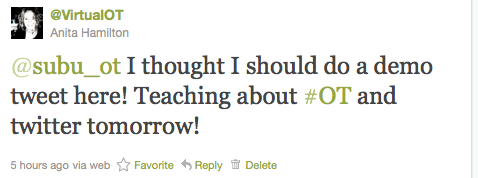
@:  Use this to inform a person that you are directing a Tweet towards them (e.g. @VirtualOT). 
Find people:  This means “find people to follow”. 
Follow/Following:  By following someone you will see all his or her tweets on your page.  You can choose to follow anyone who allows it; sometimes you will get a message saying they need to approve you.
Hashtags #:  The hashtag is used to tag a topic.  For example in OT we use #OT. 
Profile: Customized information about you that others will see on Twitter.
Tweets:  The term given to the bite-sized messages of 140 characters you send out.  Tweets can be public, private, or even direct messages.  You can only receive direct messages from people you follow and vice versa.  Re-tweets (RT's):  This is when a tweet is forwarded by another user.
Tweeps: People who use Twitter (sometimes also means people you met on Twitter).
Twittersphere:  The virtual world of Twitter.

Example Tweet using bitly (reduced URL)
Tip 4.  Be concise and informative.  You only have 140 characters to use for each Tweet, so be concise!  Think of Twitter as a virtual notice board with the capacity to leave notes or questions for individuals or groups about a topic.  Most health care Twitter use this forum post information, look for answers or brainstorm a problem.   Examples include looking for a resource, a supplier or to share news on funding changes for OT services.  If you need to add a website URL these can be very long.  To get around this use bitly or tinyurl to shrink the url address so it can fit in your 140 characters more easily.
Example Tweet hashtag #OT

Tip 5. Use #tags - hashtags.  Hashtags have made a huge difference to finding information on Twitter.   These are the best way to have non-followers see your tweets and for followers to notice Tweets of shared importance.  For a current list of Twitter hashtags that are of interest to OTs, see Twitter Hashtags List.  A helpful website is WTH: What the Hashtag, an editable encyclopaedia for hashtags found on Twitter.  Experiment with hashtags as they specify your interests.  You can invent your own hashtags (e.g. we created #OT4OT which is online technology for occupational therapy).


Tweetdeck helps organize top
Tip 6.  Use technology to organize your Tweets! The basic Twitter site will show you a constant feed of information from people you follow.  However there will be people in the "Twitterspehere" posting about topics you are interested in.  You need a way to collect and organize Tweets by topic.  There are a number of Apps for phones and computers to help you organize tweets by topic.  TweetDeck, HootSuite, and TweetCaster help you organize your Twitter account for your phone, desktop computer, iPad, laptop etc.  It can be daunting to work out which App to use, I have settled with Tweetdeck and am happy with its performance.  On my Tweetdeck I leave a search column open at all times for the terms #OT, #Virtual-World-OT-Day, #OccupationalTherapy, and #OT4OT.  I also use these hashtags frequently when chatting with my OT Twitter friends. 

Linking Twitter to Facebook
Tip 7. Set-up an RSS feed—Twitter is an especially powerful networking tool when combined with a blog or Facebook account.  You can set up Twitter to direct Tweets to your Facebook wall (if you want) and you can also set up a feed from Twitter to your blog.  Using these tools you will be able to post information just once and have it available in three different online forums!  Note: Another great way to get more impact from your blog is to set up Networked Blogs in Facebook to re-post blog posts on your Facebook wall.    

@enableOT created an OT list in Twitter
Tip 8. Find people to followTo find people you can use findpeople link in Twitter.  Once you follow one person, you can look to see who follows them and then click the “follow” button to add them to the list of people you follow.  There are also directories such as wefollow.com where you can search for people by keyword.  To find other OTs on Twitter start with @enableOTs occupational therapy list and from there you will find many other lists of OTs under areas of practice or topics of interest.  

Tip 9. Be selective about who to follow back—Once you’ve been on Twitter for a while, people will begin to follow you.  Don't feel compelled to follow everyone back, they may even turn out to be a spam-bot or simply a person whose interests don't align with yours. When deciding whether or not to follow-back, look at the user’s profile and see if their profile and interests match yours, read some of their recent Tweets and see if you'd like to "converse" with them.

#FollowFriday is a great tool to find OTs in Twitter
Tip 10. Make use of #FF.  Follow Friday #FF is the hashtag to help people find new Twitter friends. On Fridays "Tweeps" recommend people they think others should be following.  Take advantage of these days, follow the people your friends recommend and then re-tweet the recommendation to let the recommended know that you are now following him or her.  Apps like FollowFridayRanking help keep track of who is being recommended!

Thursday, April 28, 2011

Hearing help in the developing world: An unconventional approach

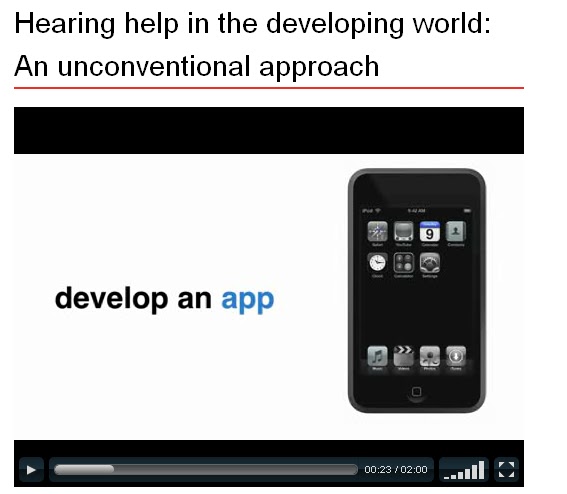
Bill Hodgetts, an audiologist at the University of Alberta, has a big idea!  Bill would like to develop an app that tests hearing and then use the ipod as a hearing device, as a personal amplification system!


He writes:
Hearing loss and deafness affect at least 278 million people worldwide, two thirds of whom live in developing countries with limited care. My idea is to use an iPod touch to test hearing (point of care diagnostics) and then use the same device and headphones as a personal amplification device to give people greater access to the world of sound.
So, if you agree that this is a good idea, please help Bill to get funding by visiting the website and clicking "like"!

My slideshare uploads